Healthcare
When Clinical Systems Go Down, the Consequences Are Measured in Patient Outcomes
Australian healthcare has become the most targeted sector for data breaches in the country — accounting for a higher share of reported incidents than finance, government or any other industry. The stakes are not financial recovery alone. When networks fail or ransomware encrypts an EMR system, procedures are delayed, ambulances are diverted, and clinical decisions are made without the information they depend on.
Orro works with hospital networks, primary health networks, aged care providers, pathology groups, and private health facilities to design, secure and manage the technology infrastructure that clinical environments run on — from the wide area network connecting distributed sites to the security operations capability monitoring threats in real time.
Healthcare accounts for 20% of all notifiable data breach reports in Australia — the highest of any sector, every reporting period since 2023. Source: OAIC Notifiable Data Breaches Report, July–December 2024 — oaic.gov.au
Ransomware incidents targeting Australian healthcare doubled in FY2024–25 compared to the previous year, with malicious actors succeeding in 95% of sector incidents ASD’s ACSC responded to. Source: ASD Annual Cyber Threat Report 2024–25 — cyber.gov.au
Australians had their health and prescription data compromised in the 2024 MediSecure ransomware attack — one of the largest data breaches in Australian history. Source: Australian Government, Home Affairs — homeaffairs.gov.au
The global average cost of a healthcare data breach in 2024 — the highest of any industry, a position healthcare has held for fourteen consecutive years. Source: IBM Cost of a Data Breach Report 2024 — ibm.com
Healthcare Under Persistent Pressure
Healthcare is, by the data, Australia’s most breached sector. The OAIC’s Notifiable Data Breaches reporting has consistently placed health service providers at the top of its sector league table — accounting for 20% of all notifications in the second half of 2024, and 18% in the first half of 2025. This is not a statistical anomaly. It reflects a structural convergence of high-value data, operationally critical systems, constrained IT resources, and an attack surface that has expanded faster than most organisations’ ability to manage it.
Why this sector is targeted: Patient health data is among the most valuable categories of personal information on the criminal market. Unlike a compromised credit card number that can be cancelled, health records — encompassing diagnoses, medications, procedures, Medicare identifiers, and family history — are permanent. They support identity fraud at scale, insurance fraud, and targeted extortion. The MediSecure ransomware attack in April 2024 compromised approximately 12.9 million Australians’ prescription records, representing data on nearly half the country’s population. The breach forced the company into liquidation. In December 2023, St Vincent’s Health Australia — the country’s largest non-profit healthcare provider — experienced a cyberattack that resulted in data being removed from its network across hospitals and aged care facilities in multiple states. In early 2025, Victorian hospital group Epworth Healthcare was the subject of alleged data theft by the Global Group ransomware gang, with 40GB of data including patient records, medical imaging, and internal payroll information reportedly posted to the dark web. IVF provider Genea also suffered a ransomware intrusion in February 2025, with the Termite group claiming responsibility for exfiltrating nearly 940GB of patient records. These are not isolated events — they are the visible portion of a much larger pattern.
The structural vulnerabilities: ASD’s 2024–25 Annual Cyber Threat Report recorded that malicious actors succeeded in 95% of healthcare sector incidents the ACSC responded to — compared to 52% across all sectors. That figure is not primarily a reflection of poor intent on the part of healthcare organisations; it reflects the structural conditions under which they operate. Healthcare IT environments are characterised by a sprawl of legacy clinical systems, many running operating systems no longer receiving security updates. Medical devices — infusion pumps, patient monitors, imaging equipment, anaesthesia systems — are networked, often running embedded firmware that cannot be easily patched, and were designed for clinical performance rather than security. These Internet of Medical Things (IoMT) assets sit on the same underlying network infrastructure as administrative systems, creating lateral movement opportunities that skilled threat actors actively exploit. Add to this the ongoing digitisation of clinical workflows — electronic medical record (EMR) systems, telehealth platforms, digital imaging and pathology repositories — and the scope of the problem becomes clear. Each new system is a dependency. Each dependency is a potential failure point.
The operational stakes: The consequences of a clinical technology failure extend well beyond financial and reputational harm. When ransomware encrypts an EMR system, clinicians lose access to medication histories, allergy records, and diagnostic information at the point of care. Procedures must be postponed. Ambulances are diverted to other facilities, increasing pressure on the wider system. Staff revert to manual paper-based workflows, introducing both error risk and operational delay. Research published in academic literature has found that hospitals neighbouring a ransomware-attacked facility experience measurable spikes in emergency department presentations while the affected site deals with reduced capacity. In aged care environments, the stakes are equally serious: medication management, incident documentation, and care coordination systems all depend on network availability. A prolonged outage is not an inconvenience — it is a governance failure with direct implications for resident safety.
The distributed network reality: Most hospital networks, primary health networks, and aged care groups operate across multiple sites — a combination of metropolitan hospitals, community health centres, regional facilities, rural GP practices, and residential care sites, frequently connected through a mix of carrier-grade WAN, legacy MPLS, and in some cases, site-level broadband connections with variable quality and redundancy. The push toward centralised EMR platforms (such as Epic, Cerner, and local deployments) has increased the criticality of wide area network reliability: a degraded WAN connection is no longer just a productivity issue, it can directly impair clinical workflows. The rise of telehealth — accelerated substantially during the COVID-19 period and now a permanent fixture in outpatient and primary care models — has added further demands on bandwidth, latency, and uptime. In aged care, connectivity requirements have expanded to include resident-facing technology, staff communication platforms, and the monitoring systems underpinning clinical governance. Managing this environment consistently across dozens or hundreds of sites, often with small central IT teams, is one of the defining operational challenges for healthcare technology leaders.
Regulatory pressure and the governance gap: Healthcare is subject to a layered compliance environment that has grown significantly more demanding. The Security of Critical Infrastructure Act 2018 (SOCI Act) now designates critical hospitals — specifically those with general intensive care units — as critical infrastructure, imposing obligations on owners and operators regarding risk management programmes, incident reporting, and government access for purposes of national security. The My Health Records Act 2012 imposes specific obligations on healthcare providers connecting to the national digital health infrastructure, including mandatory security requirements for clinical information systems. The Privacy Act 1988 and the Notifiable Data Breaches scheme apply to all private health service providers regardless of annual turnover — a threshold that does not apply to other sectors. The Cyber Security Act 2024 introduced mandatory ransomware reporting obligations for organisations over $3M turnover. And the Australian Digital Health Agency continues to expand its security framework requirements for participants in the national digital health ecosystem. For many healthcare organisations — particularly private hospital operators, pathology groups, and aged care providers — building governance maturity fast enough to meet these obligations while simultaneously managing complex day-to-day operations is a genuine challenge. The regulatory frameworks are right to demand higher standards. The gap between where many organisations currently sit and what is now required is the territory where risk concentrates.
Regulatory Frameworks Applicable to Australian Healthcare
We understand that every industry faces unique challenges when it comes to IT, security, and digital infrastructure.
At Orro, we combine deep sector knowledge with cutting-edge technology to deliver tailored solutions that drive performance, resilience, and growth. Whether you’re in education, finance, healthcare, retail, or logistics, we partner with you to future-proof your organisation and securely connect everything.
My Health Records Act 2012
Governing body
Australian Digital Health Agency (ADHA) — digitalhealth.gov.au
What it requires
Healthcare providers accessing or connecting to the My Health Record system must implement security controls aligned with ADHA’s security requirements framework, maintain audit logs of access, and notify the ADHA and OAIC of breaches affecting My Health Record data.
Applies to
All registered healthcare providers participating in the My Health Record system.
Consequence of non-compliance
Civil penalties, suspension or deregistration from the system, mandatory breach reporting obligations.
Privacy Act 1988 — Notifiable Data Breaches Scheme
Governing body
Office of the Australian Information Commissioner (OAIC) — oaic.gov.au
What it requires
All private health service providers (regardless of annual turnover) must notify the OAIC and affected individuals of eligible data breaches — those likely to result in serious harm. Health service providers are a specifically designated category under the Privacy Act with broader obligations than general businesses.
Applies to
All private sector health service providers, including private hospitals, aged care, allied health, pathology, radiology, GPs, and digital health platforms.
Consequence of non-compliance
Civil penalties up to $50M for serious or repeated contraventions following 2022 Privacy Act amendments.
Security of Critical Infrastructure Act 2018 (SOCI Act, amended 2022)
Governing body
Department of Home Affairs / Cyber and Infrastructure Security Centre (CISC) — cisc.gov.au
What it requires
Responsible entities for critical healthcare assets (hospitals with general ICUs) must register assets, implement a Critical Infrastructure Risk Management Programme (CIRMP), report serious cyber incidents within 12 hours and other incidents within 72 hours, and comply with government assistance directions.
Applies to
Hospitals designated as critical infrastructure — primarily large public hospitals and network operators with general intensive care units.
Consequence of non-compliance
Civil penalties; government intervention powers under the Act.
Cyber Security Act 2024
Governing body
Australian Signals Directorate / Department of Home Affairs — cyber.gov.au
What it requires
Mandatory reporting of ransomware payments to the Australian Government for organisations with annual turnovers exceeding $3M. The Act also establishes a Cyber Incident Review Board and strengthens ASD’s assistance powers for significant incidents.
Applies to
All healthcare organisations above the $3M turnover threshold — which includes virtually all hospital operators, specialist clinics, pathology groups, and aged care operators of any material size.
Consequence of non-compliance
Civil penalties for failure to report ransomware payments within the prescribed timeframe.
ASD Essential Eight Maturity Model
Governing body
Australian Signals Directorate — cyber.gov.au
What it requires
The Essential Eight defines eight baseline mitigation strategies across application control, patching, macro restrictions, multi-factor authentication, user permissions, backup procedures, and system hardening. Maturity Levels 0–3 provide a structured uplift pathway.
Applies to
De facto baseline for all sectors; increasingly referenced in health sector procurement and cyber insurance requirements. Mandated for Commonwealth-funded aged care providers under some frameworks.
Consequence of non-compliance
Increased exposure to successful attacks; may affect cyber insurance eligibility and public procurement.
AHPRA and Professional Registration Obligations
Governing body
Australian Health Practitioner Regulation Agency (AHPRA) — ahpra.gov.au
What it requires
While AHPRA does not directly regulate IT systems, it governs the professional obligations of registered practitioners, including obligations to maintain patient confidentiality and exercise appropriate professional judgment. A cyber incident that compromises patient records may have professional registration implications for practitioners responsible for that data.
Applies to
All AHPRA-registered practitioners in clinical practice.
"Healthcare organisations are being asked to run some of the most operationally complex IT environments in Australia — distributed across dozens or hundreds of sites, dependent on real-time application performance, and increasingly targeted by threat actors who understand that downtime here carries consequences that don't apply anywhere else. What we see consistently is that the organisations managing this well aren't necessarily the largest or best-resourced. They're the ones that have connected their network and security operations — so the team managing connectivity visibility can see the same picture as the team responding to a potential intrusion. The separation of those functions is where a lot of risk hides. Getting them unified is where the meaningful improvement happens."
Chief Technology Officer – Orro
How Orro Supports Healthcare Organisations
1. Secure, High-Performance Connectivity Across Care Facilities
Healthcare networks bear a connectivity burden that most other sectors do not. A hospital campus may simultaneously need to support clinical mobility (nurses and doctors accessing EMR systems from mobile devices and workstations at point of care), high-bandwidth medical imaging transfers (CT, MRI and pathology data moving between facilities and reporting services), segregated guest Wi-Fi for patients and visitors, and the operational technology networks underpinning building management, nurse call, and physical access systems. Each of these requires different performance characteristics, different security postures, and ideally, different network segments to limit the blast radius of any compromise.
Orro designs and manages healthcare network infrastructure across campus, multi-site, and distributed care environments. Our SD-WAN and SASE deployments provide application-aware routing that prioritises clinical traffic — ensuring EMR systems and imaging platforms maintain consistent performance even during peak load — while providing zero-trust access controls for remote clinicians, telehealth practitioners, and staff working across sites. For aged care and community health operators with large numbers of smaller sites, our managed connectivity services provide consistent standards, centralised visibility, and carrier-agnostic redundancy to maintain connectivity where a single carrier outage would otherwise leave a facility isolated.
Where campus-scale wireless is required — across hospital campuses with high device density, multi-storey facilities, or outdoor clinical areas — Orro’s wireless design and management capability, including private LTE where appropriate, delivers the coverage and performance that clinical mobility demands.
Outcome: Clinical staff maintain access to the systems they depend on, across every site, with the consistency and resilience that patient safety requires.
2. Cybersecurity and CTEM for Healthcare Environments
The healthcare threat landscape is specific enough that generic security approaches consistently underperform. Most clinical environments contain categories of assets that standard vulnerability management tools misidentify, cannot assess, or cannot safely test — including medical devices, building systems, and clinical IoT infrastructure. Attackers targeting healthcare understand this. They specifically seek out unmanaged assets and network segments that security tooling overlooks.
Orro’s National Cyber Defence Centre provides 24/7 security monitoring and response, purpose-built for the Australian threat environment. Our analysts work with healthcare-specific context — understanding that a spike in traffic from an infusion pump network is not equivalent to a spike from a corporate workstation, and that containment actions in a clinical environment must be evaluated against patient safety impact before being executed. We integrate with the EMR, clinical system, and operational technology environments our healthcare clients run, rather than treating them as out-of-scope.
Orro’s CTEM (Continuous Threat Exposure Management) service moves healthcare security posture beyond point-in-time assessments to continuous visibility of the organisation’s exposure surface. Rather than running a penetration test once a year and producing a remediation list that competes for prioritisation against a hundred other IT projects, CTEM provides ongoing identification, contextualisation, and risk-prioritised remediation of exposures across the full environment — including the IoMT devices, legacy clinical systems, and third-party-connected infrastructure that traditional vulnerability programmes typically miss. For healthcare organisations subject to My Health Records Act security requirements, SOCI Act obligations, or Essential Eight uplift commitments, CTEM provides the ongoing assurance evidence that point-in-time testing cannot.
Outcome: Continuous, healthcare-contextualised threat visibility and rapid response, without creating operational risk to clinical systems in the process.
3. Cloud and Application Performance for Clinical Environments
The clinical application stack in a modern healthcare organisation is almost entirely dependent on high-performance, highly available network and cloud infrastructure. EMR platforms like Epic and Cerner, digital imaging and archiving systems (PACS), telehealth platforms, pathology middleware, and clinical decision support tools all require consistent latency, reliable connectivity, and robust disaster recovery capability. A system that was merely inconvenient to lose in a pre-digital clinical environment is now genuinely safety-critical.
Orro’s managed cloud and application performance services are designed for the specific demands of healthcare workloads. We work with healthcare organisations to architect and manage cloud environments that support clinical application performance — including hybrid deployments where on-premises infrastructure must integrate seamlessly with cloud-hosted services — with data sovereignty and privacy requirements built into the design rather than retrofitted. Our business continuity and disaster recovery capability ensures that when an incident occurs, the recovery pathway for clinical systems is planned, tested, and executable within defined time objectives. Many healthcare IT teams operate with insufficient internal capacity to maintain and test their DR programmes rigorously; Orro’s managed services model absorbs that burden.
Outcome: Clinical applications perform reliably at every site, with a tested recovery capability that meets the organisation’s patient safety and regulatory obligations.
4. Clinical IoT and Connected Device Security
The proliferation of connected medical devices has created a new and often poorly understood category of security risk. Infusion pumps, patient monitors, ventilators, imaging equipment, nurse call systems, medication dispensing units, and building management platforms now all communicate over IP networks. Many of these devices run operating systems that cannot be patched on a normal cycle, have default credentials that were never changed at installation, and lack the logging and telemetry capabilities that security operations depend on. They were designed, validated, and deployed for clinical function — security was not part of the original design brief.
Orro’s OT and clinical IoT security capability addresses this challenge directly. We conduct asset discovery and classification across the clinical device and operational technology environment — creating the visibility that most healthcare organisations currently lack — and implement network segmentation, monitoring, and access controls that limit the exposure of clinical devices without interfering with their function. Our approach acknowledges that a traditional endpoint security agent cannot be deployed to an infusion pump; the security architecture must account for the device characteristics, not assume capabilities they do not have. Where building systems, HVAC, physical access, and power management platforms intersect with clinical and IT infrastructure, we ensure appropriate segmentation and monitoring are in place across that boundary.
Outcome: Connected medical devices and operational technology assets are visible, classified, appropriately segmented, and monitored — without operational disruption to clinical workflows.
5. Operational Excellence and Managed Services for Healthcare IT
Healthcare IT teams operate under persistent pressure. Most clinical environments have grown in complexity faster than IT team capacity has grown to match. The expectation that a small internal team can manage a multi-site WAN, maintain network security posture, run a meaningful vulnerability programme, support clinical application performance, and respond to incidents — while simultaneously handling end-user support, vendor management, and project delivery — is not realistic for most organisations below the scale of a large metropolitan health network.
Orro’s managed services model provides healthcare technology leaders with the operational capacity and specialist depth that internal teams cannot sustainably maintain. Our One Touch Control platform provides unified, real-time visibility across multi-vendor, multi-carrier network infrastructure — giving both Orro’s operations team and our clients’ internal staff a single operational picture, regardless of the number of sites, carriers, or equipment vendors involved. Proactive monitoring allows our team to identify and resolve network degradation before it becomes a clinical outage: the most expensive kind of incident to manage. For organisations that have experienced the cycle of reactive firefighting that comes with under-resourced IT operations, the shift to a proactive managed services model is transformative.
For healthcare CIOs and IT Directors managing board-level expectations around technology risk, One Touch Control also provides the reporting and visibility needed to demonstrate that infrastructure is being actively managed, that SLAs are being met, and that the organisation has a credible operational story to tell — to boards, regulators, and insurers.
Outcome: Healthcare technology runs reliably, IT teams focus on strategic priorities rather than operational firefighting, and the organisation has the visibility and evidence it needs to demonstrate responsible infrastructure governance.
Demonstrated Capability at Scale
Orro has delivered network transformation for one of Australia’s largest private hospital operators — a national network spanning every state and territory, with the connectivity demands, clinical system dependencies, and availability requirements that large-scale acute care environments create. Orro designed and deployed a high-availability managed network architecture across the hospital group’s sites, providing the secure, resilient connectivity that clinical systems — EMR, imaging, medication management, staff mobility — depend on to function. As part of that transformation, available bandwidth was quadrupled, enabling the organisation to support the volume and performance demands of modern clinical workflows across its facilities. The engagement demonstrates Orro’s ability to work within the specific operational and governance constraints of large healthcare environments, where network changes require clinical risk assessment and downtime windows are tightly managed.

Healthcare Technology and Cybersecurity — Frequently Asked Questions
Does the SOCI Act apply to my hospital?
The SOCI Act designates hospitals with general intensive care units as critical infrastructure. If your facility operates a general ICU, you are likely subject to SOCI Act obligations, including registering the asset, implementing a Critical Infrastructure Risk Management Programme (CIRMP), and mandatory incident reporting — serious incidents within 12 hours, other incidents within 72 hours. If you operate a network of hospitals and only some have ICUs, SOCI obligations apply at the asset level for those that do, but risk programme obligations often prompt network-wide uplift. Confirm your specific obligations with your legal counsel and the Cyber and Infrastructure Security Centre (CISC).
Are all private healthcare providers subject to mandatory breach notification, regardless of size?
Yes. The Privacy Act 1988 designates private sector health service providers as a specific category that must comply with the Notifiable Data Breaches (NDB) scheme regardless of annual turnover — unlike most other businesses, for which the $3M turnover threshold applies. This means a solo GP practice, a small allied health clinic, or a single-site aged care provider all have the same mandatory notification obligations as a large hospital network if an eligible data breach occurs.
What are my obligations under the My Health Records Act regarding cybersecurity?
Healthcare providers connecting to the My Health Record system must comply with security requirements set by the Australian Digital Health Agency, including implementing controls sufficient to protect My Health Record data, maintaining audit logs of system access, and notifying the ADHA and OAIC of incidents that affect My Health Record data. The ADHA periodically updates its security requirements for registered system operators — staying current with those requirements is an ongoing obligation, not a one-time compliance exercise.
What does CTEM mean for healthcare, and how is it different from an annual penetration test?
Continuous Threat Exposure Management (CTEM) is a programme that maintains ongoing visibility of your organisation’s exposure surface rather than assessing it at a point in time. An annual penetration test tells you what was exploitable on the day the test was run; it says nothing about the exposures introduced in the months following. In healthcare, where new devices are continuously connected, clinical systems are updated, and third-party vendors maintain access for support and integration, the window between assessments is exactly where risk accumulates. CTEM addresses this by continuously identifying exposures, contextualising them against the specific risk profile of a clinical environment — including the constraints that apply to medical devices that cannot be patched on a standard cycle — and prioritising remediation in a way that reflects operational reality, not just CVSS scores.
How do you secure medical devices and clinical IoT that can't run standard endpoint security agents?
Medical devices — infusion pumps, patient monitors, imaging systems, medication dispensing — are typically unable to run conventional endpoint security agents because of their operating system limitations, validation constraints, and vendor support agreements. The correct approach is network-level control: asset discovery and classification to establish what is on the network and what it should be doing; network segmentation to isolate clinical device traffic and limit lateral movement; behavioural monitoring to detect anomalous activity from devices that cannot self-report security events; and access controls that enforce least-privilege connectivity between clinical device segments and other network zones. The goal is to build the security architecture around the device’s characteristics, rather than assuming capabilities that these devices do not have.
What should a healthcare organisation have in place before a ransomware attack, not just after?
Four things matter most: tested backup and recovery capability with defined recovery time objectives for each critical clinical system; network segmentation that limits the blast radius of a compromise before encryption propagates; 24/7 monitored detection that can identify ransomware behaviours (lateral movement, credential harvesting, bulk file access) before the payload deploys; and a documented, exercised incident response plan that includes the clinical decision-making chain — not just the IT team. Most healthcare organisations have some version of all four, but the gaps are typically in testing frequency, clinical system integration, and the speed of detection-to-response. The MediSecure breach is a useful case study: the server was encrypted in April 2024, and the organisation was not aware until later investigation. Earlier detection would have changed the outcome significantly.
How should healthcare boards think about cyber risk, and what questions should they be asking their CIO?
Healthcare boards carry governance responsibility for the organisation’s cyber resilience, and regulators — including AHPRA, OAIC, and for applicable entities, CISC — expect boards to exercise active oversight. The right questions are: What are our most critical systems, and what is our recovery time objective if each is unavailable? When did we last test that recovery capability, and what did the test reveal? What is our current Essential Eight maturity level, and what is the roadmap to uplift? Have we mapped our third-party and supply chain dependencies, and do we understand their security posture? Are we meeting our mandatory reporting obligations, and do we have a clear escalation process if an incident occurs? These questions do not require technical depth from board members — they require accountability, which is the board’s job.
What is SASE, and is it appropriate for a distributed healthcare environment?
Secure Access Service Edge (SASE) is an architecture that converges network connectivity and security functions into a cloud-delivered service. For healthcare organisations managing connectivity across many dispersed sites — community health centres, aged care facilities, specialist clinics, rural and regional locations — SASE provides a consistent security policy enforcement model regardless of where a user or device is located. Rather than backhauling all traffic to a central data centre for inspection, SASE performs security functions at the edge, which is both more efficient and more appropriate for the distributed access patterns of modern healthcare. It is particularly well-suited to organisations that have expanded their telehealth footprint, employ hybrid-working clinical and administrative staff, or have acquired new facilities over time without rationalising their network architecture.
How does Orro manage the tension between clinical availability requirements and security operations?
This is the defining tension in healthcare security, and it is not always well understood by security teams operating outside the clinical context. Security response actions that are appropriate in a corporate IT environment — isolating an endpoint, blocking outbound traffic, restarting a system — can have immediate patient safety implications if applied without clinical context. Our National Cyber Defence Centre operates with healthcare-specific playbooks that account for this: containment decisions in clinical environments require escalation and clinical-operational input, not just IT decision-making. Our managed services model also means we maintain context on each client’s environment — we know which systems are safety-critical, which devices cannot be disrupted, and what the clinical workflow dependencies are before an incident occurs, not during it.

Why Healthcare Organisations Choose Orro
Proven scale in mission-critical managed services
Orro manages Australia Post's national retail network — more than 4,000 sites — delivering 70% fewer outages and avoiding 44,000 business impact hours. The operational discipline required to run infrastructure at that scale, with that level of consequence for failure, translates directly to healthcare environments.
CTEM capability built for complex clinical environments
Orro's Continuous Threat Exposure Management service provides ongoing exposure visibility across EMR systems, clinical IoT, medical devices, and operational technology — the environments that standard vulnerability programmes consistently miss.
National Cyber Defence Centre
Orro's Australian-operated SOC provides 24/7 threat monitoring, detection, and response with healthcare-specific playbooks that account for clinical availability constraints and patient safety implications of response actions.
OT and clinical IoT security expertise
Genuine capability across the IT/OT/IoT boundary — not just network monitoring extended to devices, but purpose-built security architecture for environments where conventional endpoint controls cannot be deployed.
SD-WAN and SASE for distributed healthcare networks
Deep expertise in designing and managing connectivity across large numbers of dispersed healthcare sites, with consistent security policy enforcement and clinical application performance prioritisation built in.
One Touch Control — unified operational visibility
Orro's proprietary management platform provides real-time, multi-vendor, multi-carrier visibility across the full network estate — giving healthcare IT teams and Orro's operations centre a single operational picture, regardless of environment complexity.
Australian-owned, with Australian-based support escalation
Orro is an Australian-owned organisation with Australian-based account management and support escalation, and 24/7 global operations capability. Your environment is managed by people who understand the Australian regulatory context and the specific obligations that apply to your organisation.
Vendor-agnostic architecture
Orro is not aligned to a single vendor's technology stack. Our solutions are designed around what is right for the clinical environment — drawing from a broad ecosystem of network, security, and cloud partners rather than leading with a vendor relationship.
Resources for Healthcare Technology Leaders
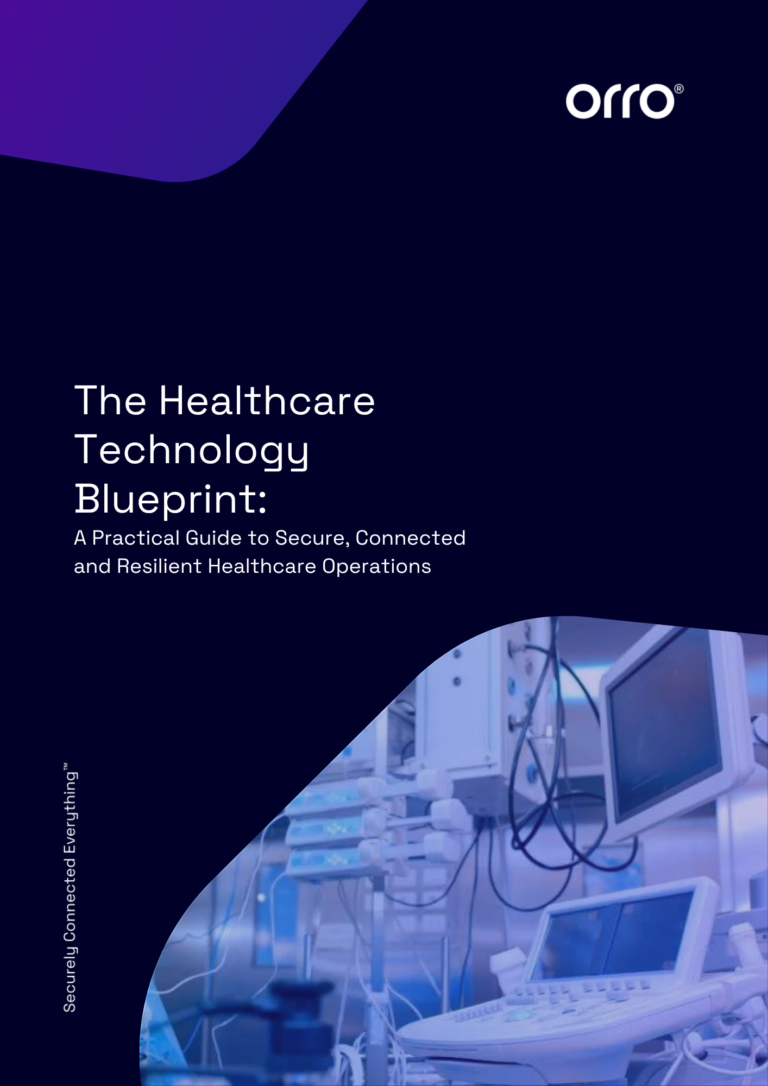
Healthcare Technology Blueprint — A practical guide to network, security, and managed services architecture for Australian hospital networks, aged care providers, and health groups.
Operationalising Intelligence: The Case for CTEM — Orro’s March 2026 thought leadership series on Continuous Threat Exposure Management.
Vulnerability Backlogs: Why Exposure, Not Volume, Should Drive Security Priorities — How to move beyond point-in-time vulnerability counts to a risk-prioritised exposure management approach.
Orro National Cyber Defence Centre — Orro’s 24/7 Australian-operated SOC capability.
Orro Managed Network Services — SD-WAN, SASE, and managed connectivity for distributed environments.
Talk to a Healthcare Technology Specialist
Orro works with hospital networks, aged care providers, primary health networks, pathology groups, and private health facilities across Australia. If you are looking for a technology partner who understands the clinical, regulatory, and operational context you operate in — not just the technology — we would like to speak with you.
Our accreditations










Explore our Resources
Healthcare Technology Blueprint

Experience-First Networking: Why User Experience Is the New KPI for Modern Networks

S5-5: The Future of Healthcare with Jason Payne