

Stop drowning in vulnerability noise. Start managing exposure strategically.
Thousands of ‘critical’ alerts. Limited resources. No clear way to prioritise. Your security team knows the tools aren’t the problem—the decisions are.
Orro’s Continuous Threat Exposure Management (CTEM) service helps Australian organisations move from reactive vulnerability management to strategic exposure control—using context, not just severity, to prioritise what actually threatens your business.
If this sounds familiar, you’re not alone
Security teams across Australia are facing the same challenge: more visibility than ever before, but less clarity about what to do with it. The volume of vulnerability data has exploded, but the ability to make confident decisions hasn’t kept pace.
 Pain Point 1: Flooded with “Critical”
“We have 5,000 critical vulnerabilities. We fix 100, and tomorrow there are 5,000 more.”
Your vulnerability scanner doesn’t lie—but it doesn’t prioritise either. When everything carries a CVSS score above 8.0, everything is labelled “critical.” Your team is stuck in an endless cycle of patching without measurably reducing real risk. According to recent industry research, organisations process an average of 960 security alerts per day, with large enterprises handling over 3,000 daily alerts—yet fewer than 5% require immediate action. The rest is noise—but noise that costs time, money, and analyst morale.
Business impact: Burnout. Wasted resources. No measurable improvement in security posture despite heroic effort.
Pain Point 2: Lack of Business Context
“Our scanner tells us a server has a vulnerability, but it doesn’t know that server holds our most sensitive customer data.”
Traditional vulnerability management treats all assets equally. A CVSS 9.8 vulnerability on an isolated test server receives the same “critical” rating as the same vulnerability on your internet-facing customer database. But these represent fundamentally different levels of business risk. Without context about asset criticality, network position, and data sensitivity, you’re fixing vulnerabilities in the order your scanner finds them—not in the order that actually reduces business risk.
Business impact: You’re remediating the wrong things first, leaving the exposures that genuinely threaten business continuity unaddressed while exhausting resources on low-impact items.
Pain Point 3: Unknown Attack Surface
“We only scan what we know about. We’re worried about what we don’t see.”
Shadow IT. Forgotten cloud instances. Orphaned containers from last year’s project. Employee-spun AWS environments. Your attack surface is growing faster than your inventory can track. Traditional vulnerability scanning operates on a fundamental assumption: you know what assets exist to scan. But in modern hybrid environments—on-premise infrastructure, multiple cloud platforms, SaaS applications, and operational technology—this assumption breaks down. Research cited by Rapid7 from Gartner’s 2024 Attack Surface Management study found that only 17% of organisations are confident they can find and list at least 95% of their assets — meaning the vast majority are operating with meaningful blind spots they can’t quantify.
Business impact: Unknown exposure equals unmanaged risk. And attackers are exceptionally good at finding the blind spots.
Pain Point 4: Security vs Operations Tension
“IT Operations pushes back on patching because they don’t believe the risk is real.”
Security says “critical,” Operations says “prove it.” Without business context, every vulnerability conversation becomes a negotiation. Security teams can’t articulate why this particular patch matters more than the 4,000 others in the queue. Operations teams, rightly concerned about stability and uptime, demand justification before disrupting production systems. The result: critical remediations get delayed, relationships deteriorate, and actual risk remains unaddressed.
Business impact: Adversarial internal relationships, slow remediation cycles, and compromises that leave genuine business risks unpatched.
The problem isn’t visibility. It’s decision-making.
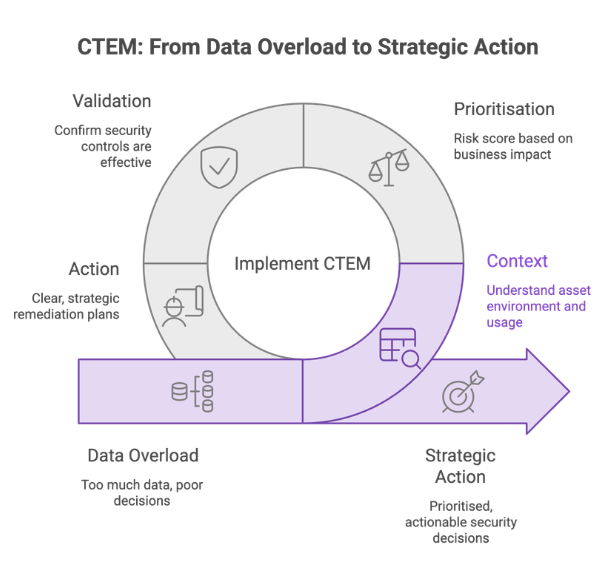
How Orro makes exposure management work in practice
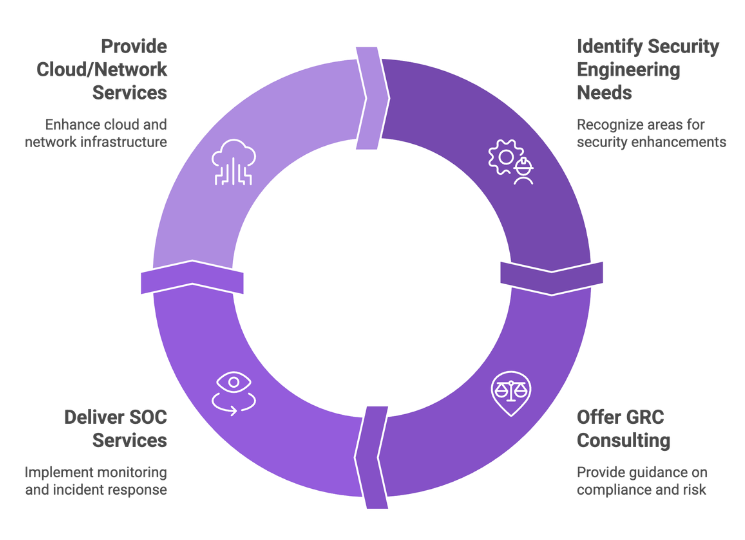
What success looks like
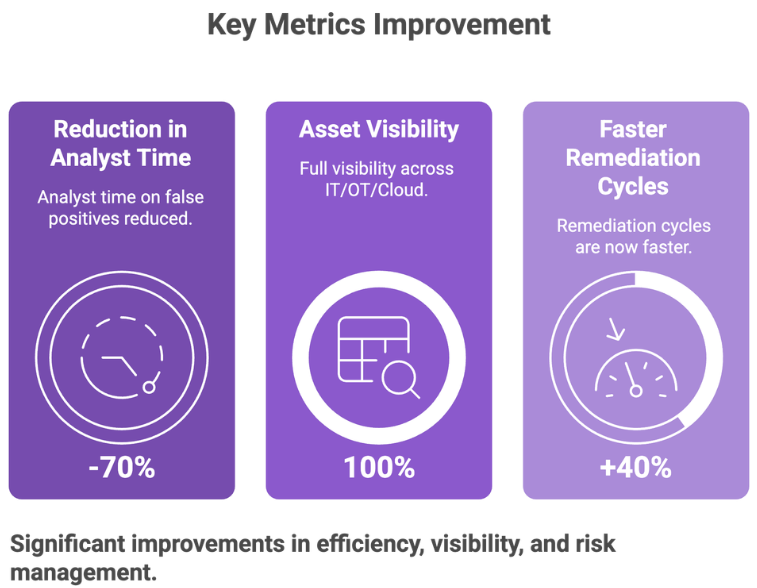
How CTEM applies across industries
 Financial Services
“Where regulatory scrutiny meets operational complexity”
Australian financial institutions face intensive oversight from APRA, increasingly sophisticated cyber threats targeting payment systems and customer data, and zero tolerance for operational disruption during critical business periods.
CTEM helps financial services organisations: – Demonstrate cyber resilience to regulators through evidence-based risk reporting – Prove systematic third-party risk management across payment networks and service providers – Quantify risk reduction for board-level reporting and regulatory submissions – Manage exposure across complex hybrid environments—trading platforms, core banking systems, customer portals, and cloud-based innovation initiatives – Prioritise remediation during high-risk periods (end of financial year, regulatory audits) without disrupting business operations
 Critical Infrastructure & Utilities
“Where exposure has physical consequences”
For organisations managing operational technology—energy generation and distribution, water treatment, transportation systems—cyber exposure isn’t just about data theft. It’s about operational continuity and physical safety.
CTEM helps critical infrastructure organisations: – Achieve IT/OT convergence visibility—understanding exposure across both corporate networks and industrial control systems – Demonstrate SOCI Act compliance readiness through systematic exposure management – Maintain operational resilience for essential services that Australians depend on – Discover shadow IT and forgotten assets in complex industrial environments where equipment lifecycles span decades – Prioritise remediations that could impact safety-critical systems differently from corporate IT
Orro’s unique capability in this space: Our OT SOC expertise means we understand exposure management where cyber risk has physical consequences—something most MSSPs simply can’t address.
 Healthcare
“Where patient safety depends on system availability”
Healthcare organisations manage Protected Health Information (PHI) subject to Privacy Act requirements, operate clinical systems where downtime directly impacts patient care, and increasingly rely on connected medical devices with embedded vulnerabilities.
CTEM helps healthcare organisations: – Prioritise exposures based on patient safety impact, not just data sensitivity – Manage vulnerability remediation in medical devices and clinical systems where patching requires vendor coordination and complex testing – Demonstrate Privacy Act compliance through systematic data protection measures – Balance security remediation against the operational imperative of continuous patient care availability – Address the unique challenge of legacy systems that can’t be easily upgraded but remain critical to operations
 Government & Public Sector
“Where public trust requires demonstrable security”
Government entities face intense scrutiny of their cybersecurity practices, must demonstrate compliance with the ISM and Essential Eight frameworks, and manage the challenge of serving the public while protecting sensitive citizen data.
CTEM helps government organisations: – Achieve and demonstrate Essential Eight maturity through evidence-based control validation – Align with whole-of-government security frameworks and shared service models – Provide transparency in risk management for ministerial briefings and public accountability – Protect citizen data across increasingly digital service delivery channels – Manage exposure across complex federated IT environments with multiple agencies and shared services
 Retail
“Where downtime directly impacts revenue”
Retail organisations operate on thin margins where every hour of point-of-sale downtime translates directly to lost revenue, manage complex supply chain systems with numerous integration points, and face intense pressure during peak trading periods.
CTEM helps retail organisations: – Prioritise exposures in payment systems and point-of-sale infrastructure that directly impact revenue – Manage supply chain and logistics system vulnerabilities that could disrupt operations – Ensure operational resilience during peak seasons (Black Friday, Christmas, end of financial year sales) – Protect customer payment data and personal information across digital and physical retail channels – Balance security remediation against the operational reality of 24/7 retail operations
Is exposure management right for you?
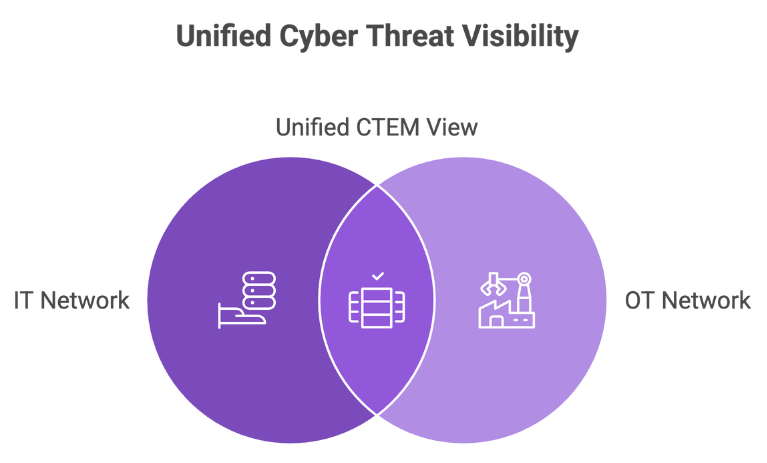
Where exposure has physical consequences
If your organisation manages operational technology alongside corporate IT, exposure management needs to reflect this reality—not just treat everything as if it were a corporate server.
Designed to meet you where you are
Understand your exposure landscape
If you’ve read this far, you’re likely dealing with the challenges CTEM is designed to solve: too much vulnerability data, not enough clarity about what actually threatens your business.
We offer two ways to explore whether exposure management makes sense for your organisation:
Path A: Cyber Governance Maturity Assessment
Not sure where you stand?
Complete a free cyber governance maturity assessment to understand your current security posture across five key capability areas: Identify & Govern, Protect, Detect, Respond, and Recover & Improve.
In 10 minutes, you’ll receive: – Your maturity score benchmarked against similar organisations – Identification of critical gaps in your security program – Personalised recommendations for improvement – A foundation for prioritising security investments
This assessment helps you understand whether your organisation has the foundational security controls in place to benefit from CTEM, or whether you need to address more fundamental gaps first.
Path B: CTEM Consultation
Ready to discuss your exposure landscape?
Request a complimentary 30-minute consultation with our exposure management team to explore how CTEM could work in your specific environment.
We’ll discuss: – Your current vulnerability management challenges and pain points – How CTEM could address these challenges in your specific context – Whether your organisation is ready for continuous exposure management or needs intermediate steps – What a phased implementation might look like given your constraints – Honest assessment of whether this investment makes sense for you right now
This isn’t a sales pitch. It’s a strategic conversation to help you understand your options. If CTEM isn’t the right fit for your organisation at this stage, we’ll tell you—and suggest what might make sense instead.
Frequently Asked Questions
No. CTEM works with your existing security investments—Qualys, Tenable, Rapid7, SentinelOne, CrowdStrike, and 100+ other platforms. We integrate data from your current tools to provide the missing context layer, not replace what’s working. Many of our clients already have vulnerability scanning in place; they come to us because they need help making sense of what those scanners are telling them.
Your Security Operations Centre focuses on detecting and responding to active threats and security incidents—monitoring for suspicious behaviour, investigating alerts, and containing breaches. CTEM focuses on identifying and prioritising exposures before they become incidents—understanding which vulnerabilities could be exploited and need remediation. Think of them as complementary capabilities: CTEM tells you what to fix before it’s exploited, your SOC detects and responds when prevention fails. Organisations operating both capabilities see the greatest risk reduction.
Traditional vulnerability assessments are point-in-time snapshots that generate long lists of findings with limited business context. You get a PDF report with hundreds or thousands of vulnerabilities, all flagged as “high” or “critical,” with minimal guidance on what to prioritise. CTEM is continuous monitoring with business context, threat intelligence, and control validation—providing ongoing prioritised guidance that evolves as your environment changes and new threats emerge. It’s the difference between an annual medical exam and ongoing health management with real-time coaching.
Most organisations see immediate value in the first 30 days through reduced alert noise, clearer remediation priorities, and actionable guidance that Security and Operations teams can align on. The strategic value compounds over time as you track risk reduction trends, validate control effectiveness, and make data-driven security investment decisions. Early adopters typically report that CTEM “pays for itself” within the first quarter through more efficient use of existing security team time.
That’s perfectly fine, and in many cases, the honest answer. We offer flexible engagement models, including lightweight options that integrate with your existing tools without requiring infrastructure deployment or long-term commitments. A complimentary consultation will help determine what makes sense for your current state—whether that’s full managed CTEM, a phased approach starting with specific high-risk environments, or foundational work on asset inventory and control validation before advancing to continuous exposure management.
CTEM delivers value for any organisation with 200+ assets across on-premise and cloud environments, regardless of total company size. We work with mid-market organisations and enterprises alike. The key indicators are environment complexity and the degree of pain your team is experiencing with current vulnerability management approaches—not company size or revenue. A 300-person financial services firm with complex hybrid infrastructure may benefit more from CTEM than a 5,000-person organisation with simple, homogeneous IT.
Unlike most CTEM providers who focus exclusively on corporate IT, Orro extends exposure management across both IT and OT environments. This is particularly valuable for critical infrastructure, manufacturing, utilities, and any organisation where cyber risk has physical consequences. Our OT SOC capability means we understand the unique constraints of industrial environments—decades-long equipment lifecycles, safety-critical systems where availability is paramount, and the reality that traditional patching approaches don’t work in OT contexts. We provide unified visibility across IT/OT while respecting the operational realities of each domain.
It means we don’t rely solely on CVSS scores to determine remediation priority. Instead, we factor in where the vulnerable asset sits in your network (internet-facing vs internal), what it’s used for (production customer database vs test environment), what data it processes (sensitive customer information vs non-sensitive test data), whether there are compensating controls (WAF protecting the application, network segmentation limiting lateral movement), and whether the vulnerability is being actively exploited in the wild. This contextual analysis means a CVSS 9.8 on a low-value asset can be appropriately deprioritised, while a CVSS 6.5 on a critical business system with no controls moves to the top of the queue. It’s risk-based prioritisation, not score-based triage.
We test attack paths to confirm that your deployed security controls are functioning as intended. For example, if you have a Web Application Firewall protecting internet-facing applications, we validate whether it’s actually blocking the attack categories it should prevent—not just assume it’s working because it’s deployed. If you have network segmentation policies intended to prevent lateral movement from corporate IT to sensitive data environments, we test whether those policies are properly configured and enforced. This control validation often surfaces gaps where controls have degraded over time, been misconfigured during deployment, or never worked as documented—providing opportunities to remediate before attackers test the same paths.
Ready to Take the Next Steps?
Whether you’re assessing readiness, planning a modernisation program or simply exploring what AI-Native Networking could mean for your environment — our team can help build a roadmap grounded in evidence, not assumptions.
Speak with an Orro Cyber Specialist